On Thursday a text from someone whom I love dearly prompted me to tweet a prayer request for all those bearing the hidden grief of miscarriage.
The response was generous, with comments appearing in many forms and from all directions, some quite unexpected....and I thought to myself, "I ought to reflect on this. It's clearly huge for so many people".
But somehow, I didn't quite want to.
That puzzled me. Though I am that strange contradiction, a shy extrovert, I much prefer to engage with people in total honesty, and a major aspect of the blog has always been as a place to do just that. To work through who I am before God in the situations of the day, and sometimes to look at the past in the light of the present.
But I've never written about my miscarriages, that I can remember.
I had so many of them, you see.
I'd only been married a few months when, unexpectedly, there was a little ring at the bottom of a test tube and I found myself joyfully pregant.
My parents were married 11 years before I appeared on the scene, and died before I thought of asking what lay at the root of the childless years...For some reason I always assumed infertility (possibly because of my mother's life long health problems) so I was jubillant that I had managed to conceive so easily.
We phoned everyone...
Just days later, I started to bleed.
As we phoned everyone again, I began to learn of just how "normal" this is.
Many had stories to tell. We were among the first of our own generation of friends to marry and attempt parenthood, but so many of our older friends shared their own stories of loss, redeemed in healthy families (our peers...who might have had brothers and sisters to be our friends too).
It didn't help much, though at least I began to realise that all the things I was feeling had been felt by others before me.
I was introduced to the Miscarriage Association and cried as I read of the experiences of others, my sisters in secret bereavement.
By the time it happened again, I had a small collection of books and pamphlets on my shelves....and mourned the lost babes whose stories were told there even as I mourned my own.
I wondered if my body, - always taken for granted as efficient, if not beloved, would forever let me down.
It was ironic - years earlier, while trying to plot a course for my life, I'd realised that my longing for children was absolutely fundamental, non-negotiable. I'd abandoned the vaguest possibility of serious singing, because a wise teacher told me
"If you can think of anything else you might ever want to do, don't attempt to make singing your career".
And now, the "anything else" seemed to be slipping out of sight.
But suddenly, - before the doctors thought I could even dream of conceiving, my period was late, the tests were positive...and this time the babe stayed safely where she belonged until, one snowy January morning Hattie Gandhi was placed in my arms and the world shone.
Medics reassured me - "just one of those things...we don't know why they happen but you'll be alright now"
But I wasn't.
Again, and again, and again.
Each loss weighed heavier, until after a particularly frightening miscarriage at 17 weeks, when blood and tears seemed set to drown my world, I gave up on God.
I lay in bed in our terraced S London house on the Sunday morning afterwards. LCM had taken HG to Mass, but our West Indian neighbours liked their music loud and that morning it was, for some reason, not their usual fare but, bizarrely, the Faure Requiem.
A work I loved, had sung many times...the work I would have chosen as music for my own funeral...and I felt nothing.
Where words and music had always been a sure route to consolation, as I flung myself sobbing into God's arms, - nothing.
I was past being angry.
There simply wasn't a relationship any more.
Nothing.
I went through the motions, attending worship because I simply didn't have the energy to explain to LCM that the whole thing was pointless.
When I could, I found ways of avoiding it, though, pleading headaches and feeling relieved when Hattie Gandhi was fractious and needed to be taken out of church.
One day I was sitting in the car outside the Brompton Oratory and something changed...
I found myself swearing away at God, using language I'd never used in any other context, the gist of which was
"You needn't think I'm going in there to talk to you, you.........................."
And there were the words, almost visible in their reality
"That's quite alright...we can just as easily talk here".
So began the long, slow process of forgiving God. The arrival of the boys helped of course, though they were never "replacements", but always, gloriously, themselves.
Time helped too.
And I woke up one morning realising we were gently, undramatically, friends again.
But I've never really made sense of that waste of life's potential, those oceans of tears wept by so many women.
I understand now that God weeps too...and that each of those babes is safe in God's arms...but for those whose arms remain empty that's never answer enough.
No wonder I've not written much about this before. I try to make this blog a place of resolution as well as honesty - but some things are beyond resolution this side of eternity.
I don't hurt any more, but I truly couldn't offer any words in answer to the prevailing question at the time "Oh God, why..."
So, once again, I invite you to pray for those bearing the hidden burden of loss that is miscarriage...
Showing posts with label healing. Show all posts
Showing posts with label healing. Show all posts
Saturday, June 20, 2009


Monday, April 28, 2008
Healing wounded history
was the theme of a remarkable diocesan day on Saturday. I went along with rather limited expectations. For reasons that I shan't go into I'm currently a member of the small "Diocesan Healing Group" but have found the few meetings I've been able to attend less than hugely engaging. Saturday was the swan song of the current leader of the group and just two weeks ago we had seriously considered cancelling it altogether, as somehow publicity did not seem to be working and bookings were distinctly slack. However, we'd had to cancel the day when it was planned a year ago, and it seemed just plain wrong to disappoint those who were hoping for another chance to hear the main speaker so we took a collective deep breath and decided to go ahead.
That was so obviously the right decision!
Saturday was warm and sunny, the best kind of spring morning - which was just as well, as the registration queue stretched from the church porch into the churchyard but people were in very good heart as I made my way along the line, sorting out name labels to speed up the process inside. From nowhere well over 100 people had appeared (our target to break even financially was, iirc, 75) and all were in good heart.
When the first session started I discovered why.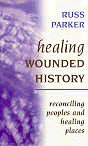 Russ Parker is simply terrific.
His theme, healing communities by hearing their stories, was completely and utterly perfect for my current situation, as I try to learn the reality of my new parishes. Its message was a glorious escape route from the pessimism that insists "History repeats itself. Has to. Nobody listens." His suggestion that the churches should become the "new acoustic communities", where stories are heard, valued and offered for redemption, chimed with Isaiah 50
"He teaches me to listen, so that I might have the word that refreshes the weary."
It seems to me that there are so many weary people around these parts, each carrying a live legacy that confirms that "all history is a current event".
Of course, we were reminded, we cannot change the past - but if we hear well, we can ensure that our response (as individuals and as a church) is appropriate.
We were reminded, too, that in serving our communities we cannot stand outside their story...The past is part of the present reality, and these people, their story, their wounds and their joys are now mine, part of what I can bring to God. The joys are important too, because what is not celebrated shrinks and dies...
I attended his first workshop session too, and felt a wave of recognition when he described the experience of the priest in the parish as often that of an actor in a play someone else has written, a play whose lines and moves we can't quite grasp. Expectations are shaped by the past experience of the community, so we need to read its history in order to help to reclaim it and to seek its redemption.
Even those mostly closely bound by it may not be aware of the story they carry, but healing can come when the story is recognised and owned.
To illustrate, Russ told us the story of a mining town, founded by the forcible transplantation of the workforce from their home county, hundreds of miles away, by a Victorian industrialist who put people second to progress. His workers were offered a stark choice...move or be unemployed. No third way was presented.
In common with most of the captains of the industrial revolution, having established his pit and built housing for his workers, the owner of the mine then built a church - and brought in a priest to serve it...not a local man...not in any sense "one of their own."
The relationship between congregation and clergy continued to be distant and strained through the decades that followed, no matter who was called to serve in that place (barring one "home grown" priest, who was remembered with respect and affection for long after his death) until, while Russ was serving there, he heard and grasped the history of the place. Then, one Sunday morning he was inspired to apologise from the pulpit for the church's collusion in the founding of a community based on exploitation and greed. As the congregation realised that their past was being honoured, they experienced the sort of healing that can change everything - and indeed everything changed.
We were invited to re-read the greetings to the churches in the opening chapters of Revelation, to see there the recognition of the story of each community and to consider what the Spirit might say to the angels of our churches. My two parishes both date from the nineteenth century, but were founded in such different circumstances that it is no surprise that difference seems built into their DNA.
To consider the story of their beginnings has certainly helped me to make sense of what I am learning about their current realities as I begin to look for God's way forward.
That was so obviously the right decision!
Saturday was warm and sunny, the best kind of spring morning - which was just as well, as the registration queue stretched from the church porch into the churchyard but people were in very good heart as I made my way along the line, sorting out name labels to speed up the process inside. From nowhere well over 100 people had appeared (our target to break even financially was, iirc, 75) and all were in good heart.
When the first session started I discovered why.
Russ Parker is simply terrific.His theme, healing communities by hearing their stories, was completely and utterly perfect for my current situation, as I try to learn the reality of my new parishes. Its message was a glorious escape route from the pessimism that insists "History repeats itself. Has to. Nobody listens." His suggestion that the churches should become the "new acoustic communities", where stories are heard, valued and offered for redemption, chimed with Isaiah 50
"He teaches me to listen, so that I might have the word that refreshes the weary."
It seems to me that there are so many weary people around these parts, each carrying a live legacy that confirms that "all history is a current event".
Of course, we were reminded, we cannot change the past - but if we hear well, we can ensure that our response (as individuals and as a church) is appropriate.
We were reminded, too, that in serving our communities we cannot stand outside their story...The past is part of the present reality, and these people, their story, their wounds and their joys are now mine, part of what I can bring to God. The joys are important too, because what is not celebrated shrinks and dies...
I attended his first workshop session too, and felt a wave of recognition when he described the experience of the priest in the parish as often that of an actor in a play someone else has written, a play whose lines and moves we can't quite grasp. Expectations are shaped by the past experience of the community, so we need to read its history in order to help to reclaim it and to seek its redemption.
Even those mostly closely bound by it may not be aware of the story they carry, but healing can come when the story is recognised and owned.
To illustrate, Russ told us the story of a mining town, founded by the forcible transplantation of the workforce from their home county, hundreds of miles away, by a Victorian industrialist who put people second to progress. His workers were offered a stark choice...move or be unemployed. No third way was presented.
In common with most of the captains of the industrial revolution, having established his pit and built housing for his workers, the owner of the mine then built a church - and brought in a priest to serve it...not a local man...not in any sense "one of their own."
The relationship between congregation and clergy continued to be distant and strained through the decades that followed, no matter who was called to serve in that place (barring one "home grown" priest, who was remembered with respect and affection for long after his death) until, while Russ was serving there, he heard and grasped the history of the place. Then, one Sunday morning he was inspired to apologise from the pulpit for the church's collusion in the founding of a community based on exploitation and greed. As the congregation realised that their past was being honoured, they experienced the sort of healing that can change everything - and indeed everything changed.
We were invited to re-read the greetings to the churches in the opening chapters of Revelation, to see there the recognition of the story of each community and to consider what the Spirit might say to the angels of our churches. My two parishes both date from the nineteenth century, but were founded in such different circumstances that it is no surprise that difference seems built into their DNA.
To consider the story of their beginnings has certainly helped me to make sense of what I am learning about their current realities as I begin to look for God's way forward.
Subscribe to:
Posts (Atom)